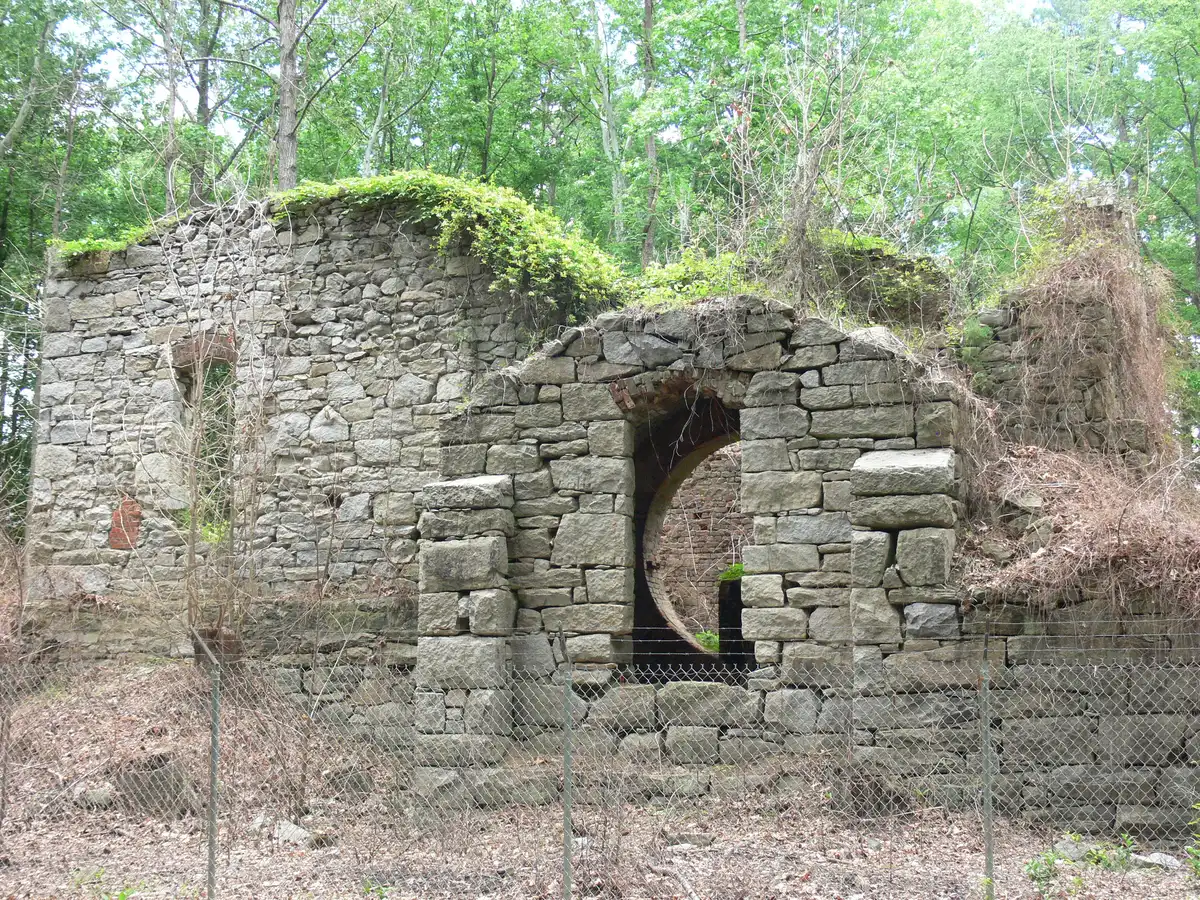
Midlothian grew around America's first commercial coal mines. See the Grove Shaft ruins at Mid-Lothian Mines Park and the area's National Register landmarks.
Last checked Oct. 19, 2026. History comes from Chesterfield County’s Mid-Lothian Mines Park page and the Virginia Department of Historic Resources (DHR) register listings, with dates from DHR’s master register list, updated through Sept. 23, 2026. Mines Park tours and programs: 804-751-4946.
Midlothian grew up around coal. Coal was discovered near the French Huguenot settlement on the James River around 1701, and the first commercially mined coal in America came from here, according to Chesterfield County. The county says the Mid-Lothian mines probably gave the village its name. Midlothian is not an incorporated town; it is an unincorporated community governed by Chesterfield County.
See it yourself
- Mid-Lothian Mines Park: 13301 N. Woolridge Road, open 6 a.m. to 8:30 p.m. daily; tours 804-751-4946
- Henricus Historical Park: 251 Henricus Park Road, Chester, open 10 a.m. to 5 p.m. Wednesday to Sunday, free; 804-748-1623
- Chesterfield Historical Society of Virginia: chesterfieldhistory.com
The coal mines: a timeline
| Year | What happened |
|---|---|
| About 1701 | Coal discovered near the Huguenot settlement on the James River |
| Mid-1730s | Commercial production begins |
| 1835 | Heirs of William Wooldridge charter the Mid-Lothian Coal Mining Company on a 404-acre tract |
| 1855 | An explosion floods the Mid-Lothian (later Pump) Shaft and kills 55 miners |
| Feb. 3, 1882 | A methane explosion traps 32 men in the Grove Shaft |
| 1920s | The Murphy Coal Corporation’s last effort to reopen the Grove Shaft fails |
| 2004 | Mid-Lothian Mines Park opens on 44 acres |
Source: Chesterfield County.
The coal seam at Mid-Lothian was about 36 feet thick and 700 feet deep, and the company’s four shafts, each 11 feet square, produced about 1 million bushels of coal a year, the county says. Coal from the mines fired the furnaces at Tredegar Iron Works in Richmond. The mines sit in the Richmond Coal Basin, about 33 miles long and 5 to 10 miles wide, across Henrico, Goochland, Hanover, Chesterfield, Powhatan and Amelia counties.
After the 1882 Grove Shaft explosion, miners from the Etna, Deep Run and Clover Hill pits walked through snow to help with rescue attempts that failed. Dr. Philip S. Hancock, a local mine physician, organized a relief committee. With members of Jerusalem Baptist Church, now Winfree Memorial, and the Midlothian Masonic Lodge, it raised money for the miners’ families for years.
The Grove Shaft ruins, a two-story granite building that once held the ventilating fans, steam boilers, pumps and hoists, are the only architectural remnant of the mining company. They stand in Mid-Lothian Mines Park beside the pond the county calls Loch Lothian.
National Register landmarks in the Midlothian area
These are listed on the Virginia Landmarks Register (VLR) and the National Register of Historic Places (NRHP), with DHR’s dates.
| Landmark | VLR | NRHP | What DHR says |
|---|---|---|---|
| Bellona Arsenal | Jan. 5, 1971 | May 6, 1971 | Foundry from 1814 and federal arsenal from 1817, served by nearby coal mines; four of eight major buildings remain |
| Trabue’s Tavern (Pleasant View) | Feb. 18, 1975 | June 10, 1975 | “A relic of Midlothian’s busy coal-producing era,” built in stages from about 1730 to 1815 |
| Hallsborough Tavern | Dec. 18, 1979 | March 17, 1980 | Wooden tavern on the old Buckingham Road, now U.S. 60, finished in 1832 |
| Bon Air Historic District | April 19, 1988 | Nov. 15, 1988 | Resort begun in 1877 that became a suburb; Victorian cottages on Buford Road |
| Hallsboro Store | 2004 | March 10, 2005 | Rural store and post office built about 1885 at Mount Hermon and Hallsboro roads |
Trabue’s Tavern was owned by the Trabues, descendants of Huguenot settlers who ran nearby coal pits, and served travelers and miners as an ordinary, DHR says. Hallsborough Tavern’s first owners, the Michaux family, were also Huguenot descendants; the Spears family owned it from 1826 to 1972.
Elsewhere in Chesterfield County, DHR lists the Chesterfield County Courthouse and Courthouse Square (NRHP 1992), the Henricus site (1972), Swift Creek Mill (1974) and Pocahontas State Park Historic District (2016), among others.
Places to visit
- Mid-Lothian Mines Park, 13301 N. Woolridge Road: the Grove Shaft ruins, trails and a boardwalk, with a virtual history tour video. Open daily, 6 a.m. to 8:30 p.m. See our parks guide.
- Henricus Historical Park, 251 Henricus Park Road, Chester: a living history park on the site of the Citie of Henricus, founded in 1611, with 14 re-created colonial buildings. Open 10 a.m. to 5 p.m. Wednesday to Sunday, last entry 4 p.m. Admission is free.
- Chesterfield Historical Society of Virginia: runs the Chesterfield County Museum, the Historic 1892 Old Jail and Magnolia Grange near the courthouse; check its website for current hours.
Related guides
- Parks and trails in Midlothian
- Midlothian population and growth
- Fall festivals, including Midlothian Day
Frequently asked questions
How did Midlothian, Virginia, get its name?
From its coal mines. Chesterfield County says the Mid-Lothian Mines probably gave the village of Midlothian its name; the Mid-Lothian Coal Mining Company was chartered in 1835.
When was coal discovered in Midlothian?
Around 1701, near the French Huguenot settlement on the James River, according to Chesterfield County. The county calls it the first commercially mined coal in America.
What happened at the Grove Shaft in 1882?
On Feb. 3, 1882, a methane explosion trapped 32 men in the Grove Shaft. Rescue attempts failed, and a relief committee raised money for the miners’ families for years.
Is Midlothian an incorporated town?
No. Midlothian is an unincorporated community governed by Chesterfield County.
What National Register sites are near Midlothian?
They include Trabue’s Tavern (listed 1975), a relic of Midlothian’s coal era, Hallsborough Tavern on U.S. 60 (1980), Bellona Arsenal (1971), Hallsboro Store (2005) and the Bon Air Historic District (1988).
Have your say